

Blogs

CTO of Netformx
More about Jacob Ukelson, D.Sc.
Your Cisco Deal Has a Lifetime Value. Are You Managing to It?
Introducing Deal Lifetime Value — a new way to quantify what a Cisco Deal is actually worth to the partner who manages it
The channel industry has Customer Lifetime Value. SaaS has ARR expansion metrics. Cisco partners have … margin on the initial booking.
That’s a problem. Because more and more a Cisco EA deal isn’t a one-time transaction — it’s a multi-year financial instrument with at least four distinct revenue streams that unlock at different points across the contract term. Partners who measure only the upfront margin are seeing a fraction of what the deal is worth. We think there’s a better way to look at it. We call it Deal Lifetime Value.
What Is Deal Lifetime Value?
Deal Lifetime Value (DLV) is the total economic return a partner earns from a single deal across its full contract lifecycle, not just at booking, but through every rebate, renewal, and expansion event the deal produces over time.
For a Cisco EA, DLV is the sum of all four LAER streams:
- Land. The VIR/Land rebate pays within a quarter of booking. It’s the number most partners already track which is typically 2–3% of net booking value. On a $15M EA, that’s roughly $400K. This is the floor, not the ceiling.
- Adopt. CPI Adopt rebates can exceed $300K on a mid-market EA, but they require completing four lifecycle stages: Implement, Use, Engage, and Adopt within 18 months. Each stage has exit criteria tied to real customer outcomes. Miss a deadline, and the entire rebate for that use case disappears. Not partially. Entirely.
- Expand/Growth. ACV Growth rebates reward portfolio expansion on a rolling basis. If the customer adds users, upgrades tiers, or expands into new technology areas, the partner earns incremental rebates year over year. This stream compounds, but only if someone is tracking consumption against entitlements.
- Renew. Renew is where the full lifecycle strategy either proves itself or fails. Successful renewals depend on everything that happened earlier in the lifecycle such as adoption success, customer engagement, expansion activity, operational health, and ongoing modernization. Partners who actively manage the customer environment throughout the EA term protect recurring revenue, reduce competitive takeover risk, improve retention, and position themselves to begin the next LAER cycle from a position of strength. A successful renewal is not just contract retention, it is the launch point for the next generation of Land, Adopt, Expand, and Renew opportunities.
Add it up, and the difference between a partner who captures only Stream 1 and a partner who captures all four is the difference between a 3% return and a 6%+ return on the same deal. On a competitive bid it can be the difference between winning the deal or wasting your time.
Cisco has made it very clear:
“63% of profitability happens after the sale.”
That statement fundamentally changes how partners should evaluate a deal. If most profitability is realized during Adopt, Growth, expansion, and renewal opportunities, then the real financial question is no longer:
“What margin did we make at booking?”
It becomes:
“How much lifetime value will this deal produce over the next five years — and do we have the operational discipline to capture it?”
That is the core idea behind Deal Lifetime Value.
Why Nobody Measures This
The channel has frameworks for measuring how valuable a partner is to a vendor (Partner Lifetime Value) and how valuable a customer is to a business (Customer Lifetime Value). But there’s been no standard framework for measuring how valuable a specific deal is to the partner who owns it across its full lifecycle.
The reason is operational, not conceptual. Capturing Streams 2 through 4 requires post-sale discipline that most partner organizations aren’t structured to deliver. The deal closes, the sales team moves on, and the 18-month Adopt clock starts ticking with no one watching it. Growth goes untracked. EoL devices sit undiscovered until a support contract lapses.
The insight isn’t that these revenue streams exist as most partners know they do. The insight is that they’re all connected, they all depend on the same post-sale activities, and they can all be managed systematically if someone owns them.
The Discipline That Unlocks DLV
That someone is a Customer Success Manager, or more precisely, a CSM operating with the right data and the right tooling.
A CSM who runs a network discovery scan at Day 1 creates the baseline that feeds every downstream calculation: Adopt stage tracking against CPI milestones, consumption monitoring for Growth and True Forward risk, and EoL device identification for the refresh pipeline. One operational investment at deal close creates visibility into four revenue streams over five years.
The objections are predictable: “We can’t afford this sort of deep analysis for every deal” and “We can’t staff a CSM on every deal.” But the framing is wrong. DLV analysis and CSM aren’t costs on the deal, consider that they’re the mechanisms that convert a one-time booking into a multi-year revenue engine. The question isn’t whether you can afford to do it, it is whether you can afford not to, when the majority of the deal’s lifetime value sits on the other side of that investment. Get the right tools and the cost of running DLV and having a CSM on every substantial deal stops being an issue.
From Transactions to Lifecycles
The partners who will win in the Cisco 360 era are the ones who stop thinking about deals as transactions and start thinking about them as lifecycles with compounding returns. Deal Lifetime Value gives that shift a number or a single metric that quantifies the full economic opportunity sitting inside every EA.
The deal doesn’t end at booking. That’s where the value starts compounding.
From Theory to Execution: Turning Deal Lifetime Value Into Measurable Profit
Understanding Deal Lifetime Value is one thing. Operationalizing it across your Cisco opportunities is another.
That’s where Netformx helps Cisco partners turn Cisco 360 strategy into measurable profitability.
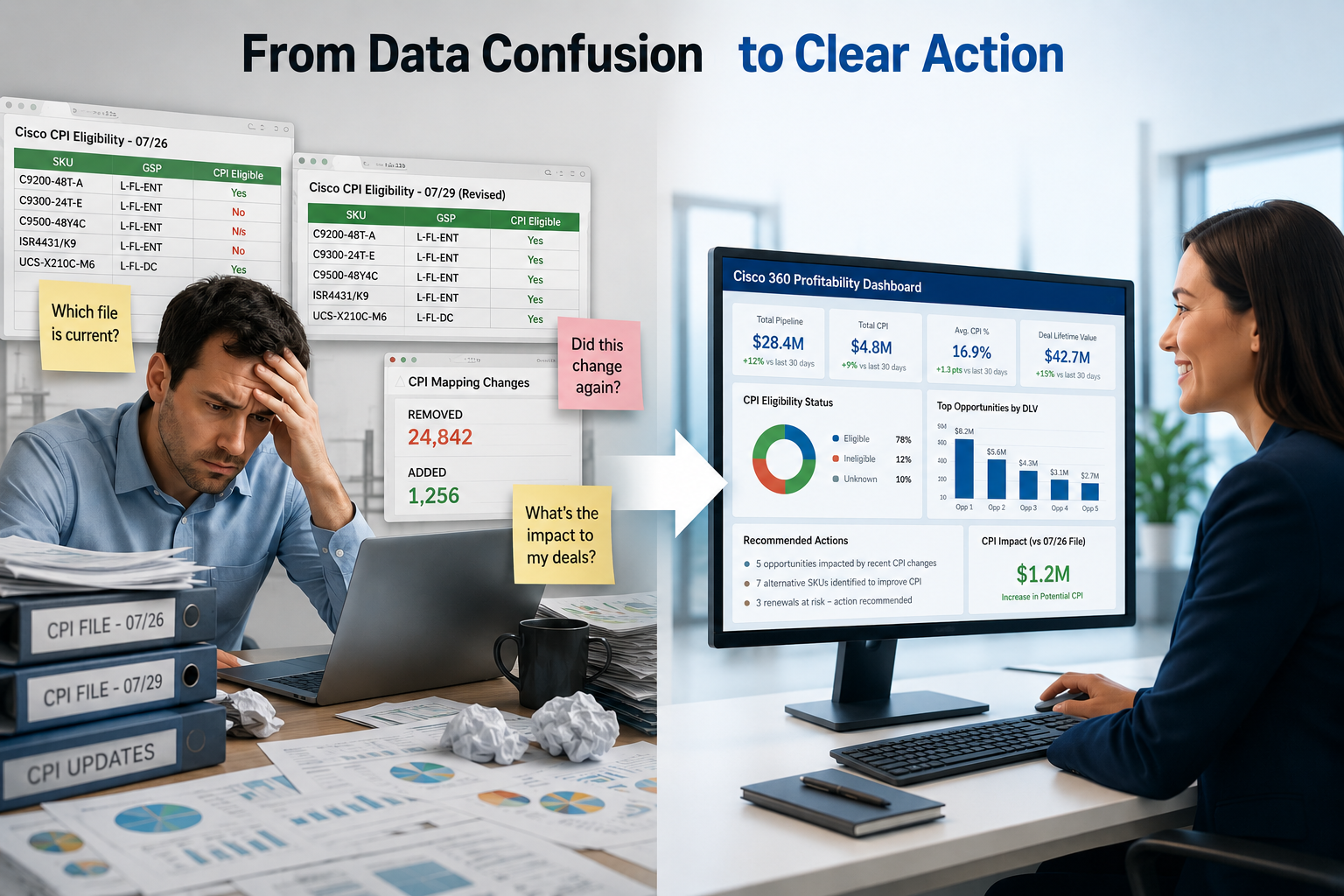
The Netformx Pipeline Insight Tool (PIT) helps partners maximize profitability before the deal closes by modeling CPI outcomes, optimizing SKUs, improving rebate efficiency, and identifying lifecycle opportunities across Land, Adopt, Expand, and Renew. Instead of quoting based only on margin, partners can model the true long-term value of the deal before submitting the proposal.
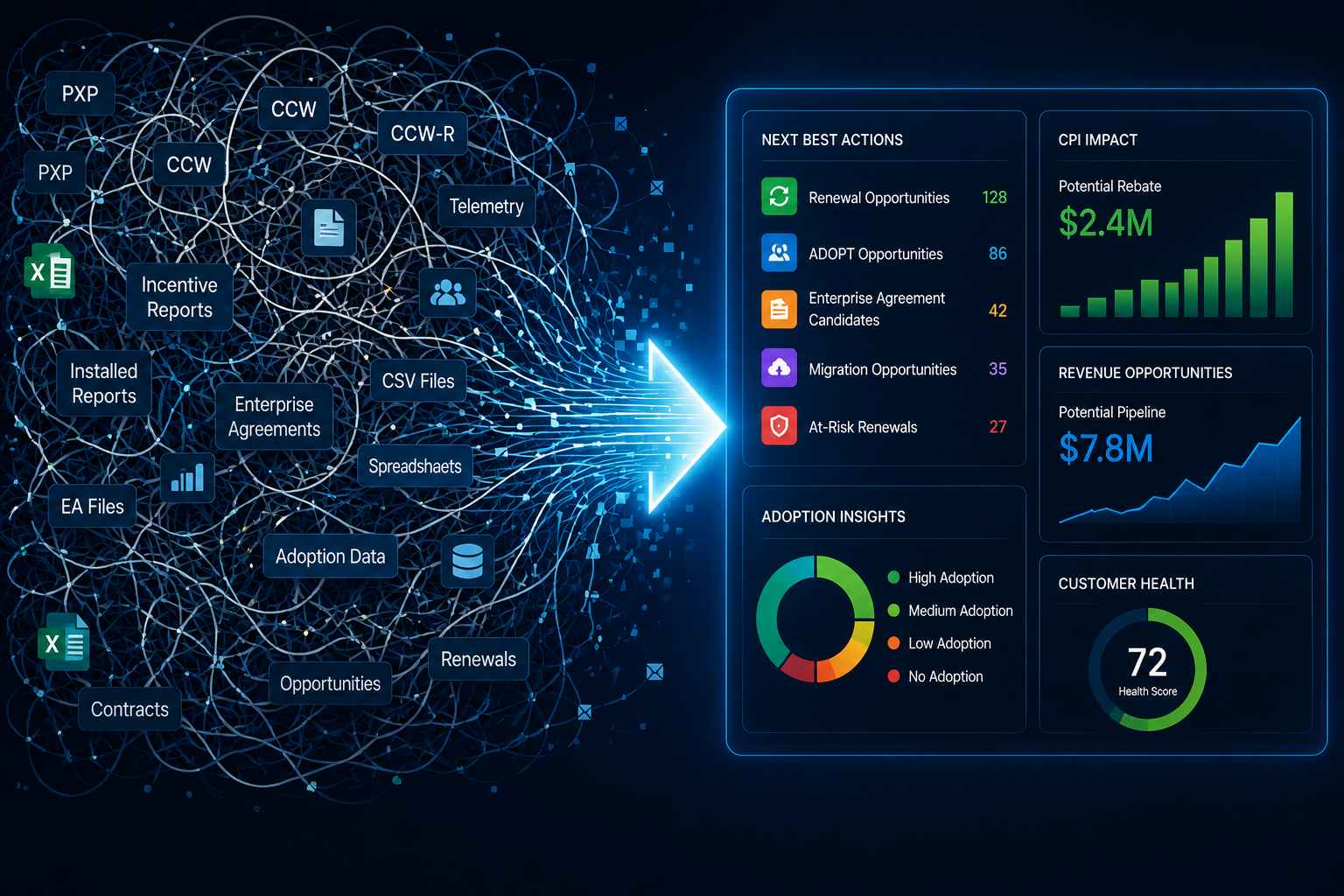
Once the deal is won, AssetXpert extends that visibility into post-sales execution. AssetXpert helps partners operationalize customer success by discovering the customer environment, identifying lifecycle and refresh opportunities, tracking Adopt milestones, monitoring growth potential, uncovering renewal risk, and creating visibility into the full Deal Lifetime Value over time.
Together, PIT and AssetXpert help Cisco partners move beyond transactional selling and build a repeatable lifecycle profitability engine aligned to Cisco 360.
Ready to See the Lifetime Value Hidden Inside Your Deals?
If you want to understand how much profitability may be sitting beyond the initial booking, request a demo of the Netformx PIT and AssetXpert platforms.
See how Cisco partners are:
- Modeling CPI profitability before the deal closes
- Planning for Adoption early with guidance on Use Case opt-in
- Increasing rebate capture across LAER
- Identifying takeover and refresh opportunities
- Tracking Adopt milestones before rebates are lost
- Turning installed base visibility into long-term growth and renewal strategy
👉 Request a demo or contact sales@netformx.com to learn more.


What is Deal Lifetime Value for Cisco Partners?
Deal Lifetime Value (DLV) is the total economic return a partner earns from a single deal across its full contract lifecycle, not just at booking, but through every rebate, refresh, and expansion event the deal produces over time.