

Blogs

CTO of Netformx
More about Jacob Ukelson, D.Sc.
Tim Coogan Is Right About Deal Registration.
But the Bigger Shift Is the One He Didn’t Say Out Loud.
In a recent CRN interview with Steven Burke, Cisco channel chief Tim Coogan made a statement that should stop every partner and distributor mid-scroll: deal registration is not a reward. It’s an investment.
That’s not spin. It’s the most consequential reframing of channel economics Cisco has made in years. And most of the ecosystem hasn’t caught up to what it actually means.
He’s telling the channel that the old mental model where you find a deal, register it, collect your discount, and move on is dead. In its place, he’s describing something closer to a joint financial commitment between Cisco, its partners, and their shared customers. Registration is the starting line, not the finish.
He’s right. But the implications run much deeper than deal registration.
The Profitability Question the Ecosystem Can’t Yet Answer
One of the most telling moments in the CRN interview came when the conversation turned to concrete profitability data — How much are partner profits up with Cisco 360? What’s the economic impact? The answers were directional: partners who invest in 360 see returns, they invest more, the program is working. And that’s likely true. But the reason no one can put precise numbers on it isn’t a Cisco problem, it’s an ecosystem problem. The channel simply doesn’t have the instrumentation to prove lifecycle profitability, deal by deal, partner by partner.
In a business built on margins and incentives, that measurement gap matters. Not because Cisco 360 isn’t delivering value, but because partners and distributors need to see that value quantified before they’ll change how they price, staff, and invest.
This isn’t a criticism of Cisco 360. The program is genuinely well-designed. It’s a criticism of how the entire ecosystem of Cisco, distributors, and partners alike continues to evaluate deals as point-in-time transactions rather than multi-year financial instruments.
The Real Shift: From Deal Margin to Deal Lifetime Value
Here’s the uncomfortable truth that the “investment not reward” framing implies but doesn’t fully articulate: if a Cisco deal is an investment, then we need to evaluate it like one. Not by the day-one margin. Not by the Land rebate alone. By the total return across the full lifecycle.
In Cisco’s own LAER framework, the economics break down roughly like this: for a typical enterprise agreement, the initial Land rebate, the number most partners anchor their pricing decisions on, represents a meaningful but incomplete fraction of the deal’s total incentive potential. The Adopt, Expand, and Renew stages that follow can represent substantially more than the Land stage itself, often dramatically so.
Yet the vast majority of partners price deals, staff engagements, and set customer expectations based almost entirely on the day-one number. They are, in this framing, treating the deal like a reward when they should be treating it like an investment — and they’re making their investment decision based on the first coupon payment rather than the total return.
This is what we mean by Deal Lifetime Value (DLV). It’s the total economic return of a Cisco deal across all four LAER stages: the booking rebate, the lifecycle incentives for driving adoption, the ACV growth from expanding the footprint, and the renewal and refresh pipeline that sustains the relationship. Most of the profit — well over half, based on the lifecycle incentive structure — comes after the initial sale.
Why This Matters Now More Than Ever
Three forces are converging to make lifecycle profitability modeling urgent rather than aspirational.
The memory shortage is compressing day-one margins. The CRN interview acknowledged that pricing is volatile and quote validity windows have shortened. In that environment, partners who evaluate deals only on the Land rebate will walk away from opportunities that are enormously profitable over their full lifecycle. The partners who can see through the volatility to the multi-year return will win the deals, and the relationship that the margin-squeezed competitors abandon.
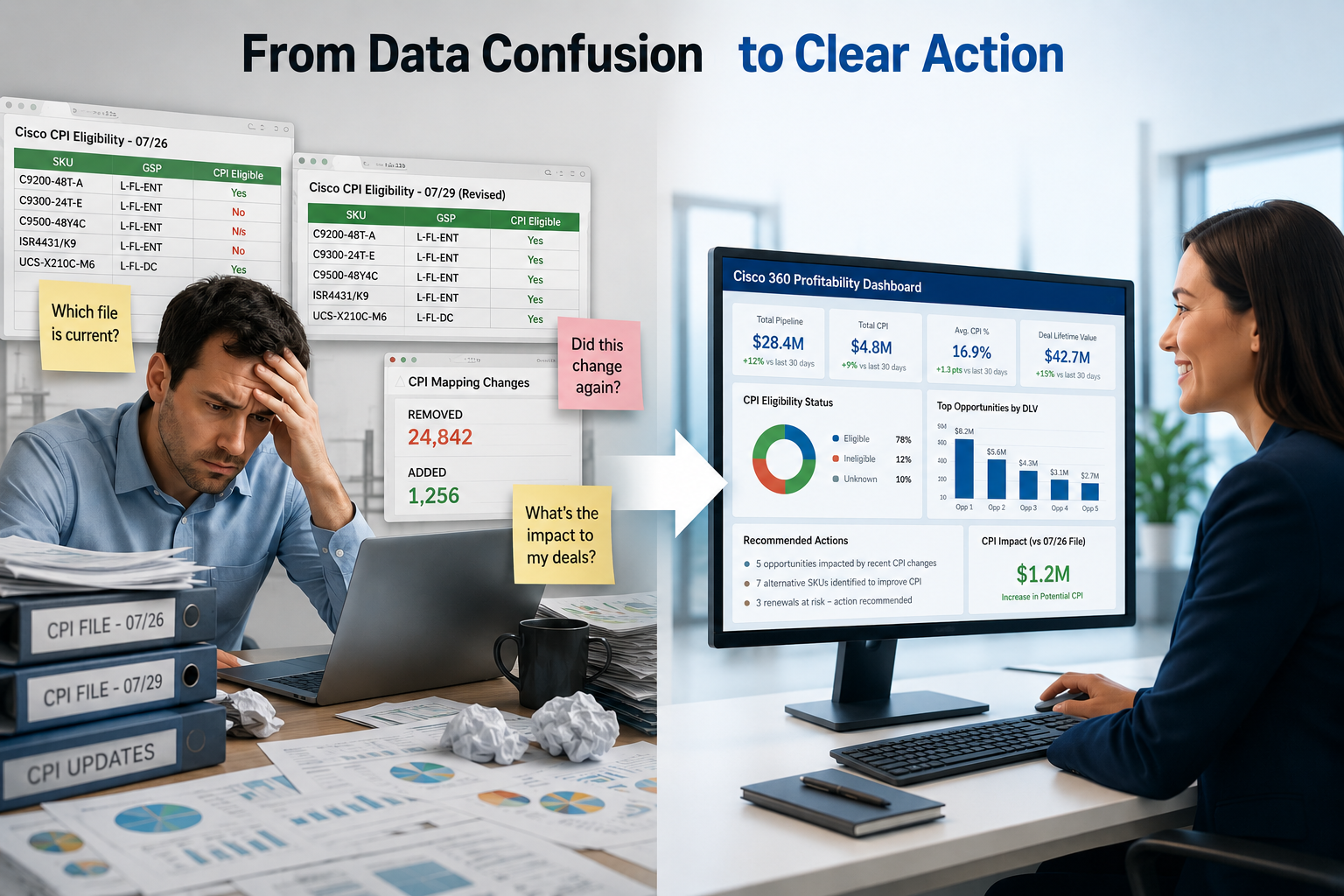
CPI complexity is growing faster than the tools to manage it. Cisco added over five thousand new CPI Adopt-eligible SKUs in a single month earlier this year, and the Adopt use-case rules continue to evolve. With an 18-month completion window on each deal, partners and enablement teams are juggling an expanding matrix of eligibility, timing, and execution often with the same spreadsheets and manual processes that worked fine when the program was simpler. The challenge isn’t effort or intent. It’s that the scale of the program has outpaced the tooling available to most of the channel.
The “One Cisco” portfolio play multiplies the modeling challenge. Cisco’s message that security is the entry point to the full portfolio means deals are getting bigger, spanning more architectures, and touching more CPI-eligible product families. A full-stack deal registered across networking, security, and collaboration has a fundamentally different DLV profile than a networking-only deal, but without lifecycle modeling, the partner can’t see that difference at the time it matters before they commit.
What This Means for Distributors
Distributors are in a unique position here, and it’s one most haven’t fully seized.
Partners already invest in customer success, and many have adopted CSM platforms to track health scores, renewals, and engagement. But those tools were designed for general SaaS lifecycle management — they weren’t built to navigate the specific complexity of Cisco’s incentive model, where profitability depends on CPI-eligible SKU mix, Adopt use-case timing, ACV growth thresholds, PVI scoring rules, and hardware refresh cycles that drive both renewal revenue and new Land opportunities. Unlike pure SaaS vendors, Cisco’s model spans physical infrastructure and software subscriptions. A partner’s lifecycle economics are shaped as much by end-of-life refresh pipelines and network assessments as by license adoption. The breadth of that model creates a gap that standard CSM tooling simply wasn’t designed to fill.
What partners also struggle to do on their own is see patterns across their full book of business, such as which customers are approaching Adopt deadlines, which deals have untapped Expand potential, and how their PVI trajectory connects to specific operational changes they could make.
This is where distributors have an opportunity. They sit across the partner base and, with the right instrumentation, could aggregate lifecycle profitability data and surface the insights that drive action.
This is the real opportunity for distribution in the Cisco 360 era: not just processing orders and extending credit but providing the profitability intelligence that helps partners make better investment decisions. The distributor who can walk into a partner conversation and say “here are the three deals in your pipeline with the highest Deal Lifetime Value, and here’s the Adopt plan that maximizes each one” is providing value that no other channel player can match.
That’s how distribution stays indispensable. Not by competing on logistics which is a race to the bottom. But by competing on intelligence.
The Technology Gap
The reason the channel doesn’t think in DLV terms today is both historical and practical. For decades, Cisco was primarily a hardware company, and the channel built its economics around product margin at the point of sale — buy low, sell at a markup, move on to the next deal. That transactional mindset made perfect sense when the business was boxes and maintenance contracts. But Cisco’s evolution into a software, subscription, and lifecycle-driven model has fundamentally changed the economics while the channel’s tooling and habits haven’t fully caught up.
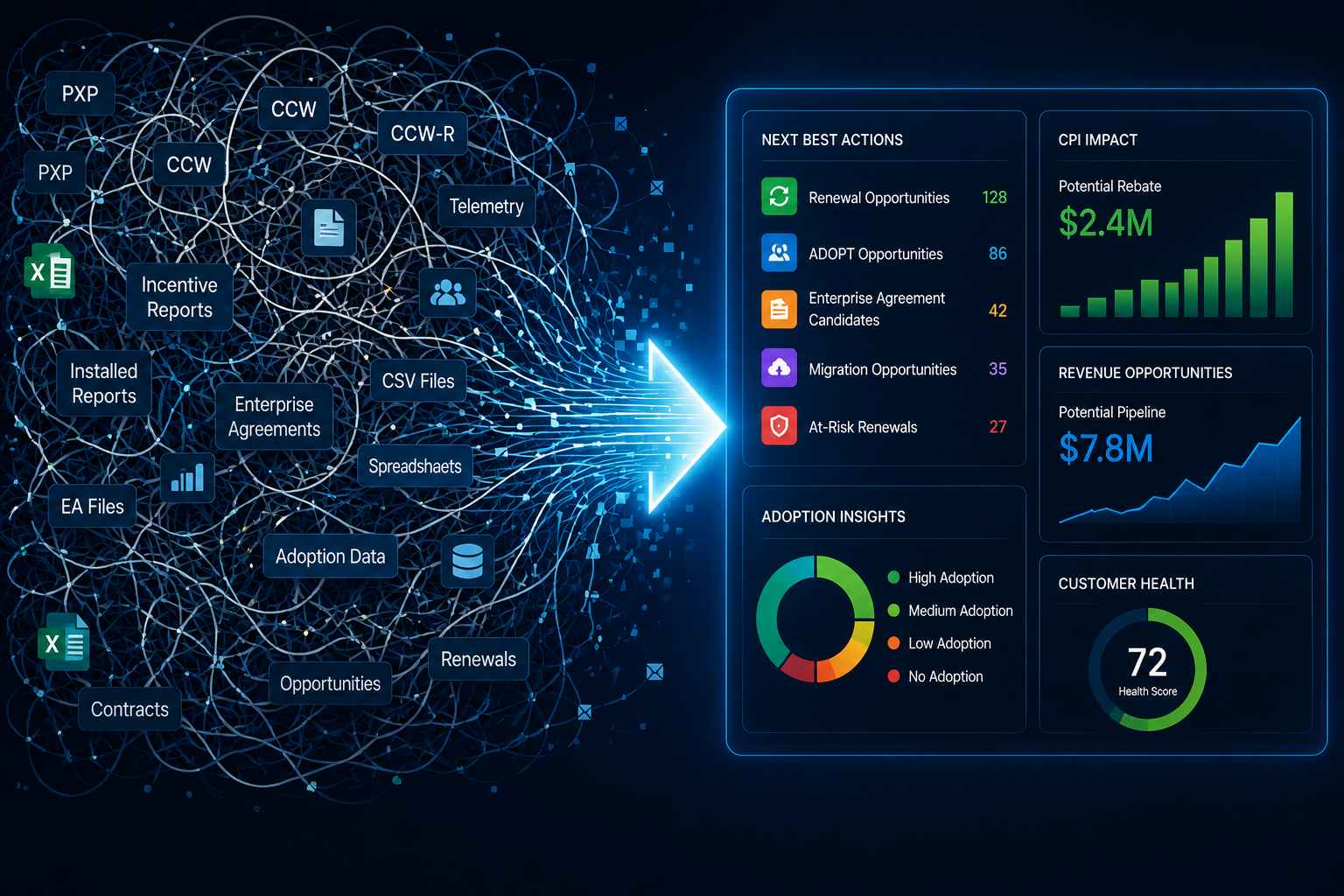
The expanding matrix of CPI eligibility, Adopt use-case rules, and ACV growth thresholds has made this gap impossible to close with spreadsheets and tribal knowledge alone. The complexity itself is forcing a new category of tooling into existence — AI-driven platforms that can model deal-level lifecycle profitability, track LAER stage progression, and connect Adopt execution to actual financial outcomes. It’s the kind of problem we’re working on at Netformx, and we’re not the only ones who see the need.
But tooling is only half the equation. The other half is the mindset shift that Cisco’s leadership is advocating for and that the channel needs to internalize.
From Reward to Investment: What It Actually Takes
If we take Cisco’s channel chief at his word, and I think we should, then the channel needs to make three changes.
First, stop pricing deals on Land alone. Every significant Cisco deal should have a DLV analysis attached to it before the partner commits. If the Adopt and Renew economics are strong enough, the deal may warrant pricing that looks aggressive at booking but delivers exceptional returns over its lifecycle. Partners can’t make that calculation if they can’t see the full picture.
Second, treat Adopt as a profit center, not a compliance exercise. Too many partners view Adopt use cases as hoops to jump through. In reality, Adopt is where the largest pool of lifecycle incentive revenue lives. The partners who build operational capability around Adopt by identifying the right use cases early, tracking completion timelines, reusing proven implementations across customers — will capture returns that their competitors don’t even know exist.
Third, demand DLV visibility from your distributor. If your disti can’t show you the lifecycle profitability of your pipeline, ask them why. If they can show you, lean in. The distributors who invest in this capability will attract and retain the partners who think like investors, which are increasingly the only partners who will thrive in the Cisco 360 model.
The Shift the Channel Must Make
Cisco’s channel chief told CRN that the company is moving from “exploring the value of AI to proving the value of AI.” The same standard should apply to Cisco 360 profitability. The industry has explored the concept. It’s time to prove it — with data, with tools, and with a DLV framework that gives partners and distributors the confidence to invest boldly in the lifecycle.
This is also an area where AI can deliver disproportionate value — not the generalized, do-everything AI that dominates the conversation today, but purpose-built profitability analysis that understands CPI eligibility rules, Adopt use-case timing, ACV growth thresholds, and the interplay between them. The lifecycle math is too dynamic and too deal-specific for static models. Partners and distributors who apply AI judiciously here to surface the highest-value Adopt tracks, flag expiring opportunities, and model DLV scenarios before pricing decisions are locked will operate with a level of precision that their competitors simply can’t match manually.
The partners who make this shift won’t just be more profitable. They’ll be the ones Cisco is talking about when the next CRN interviewer asks for proof that Cisco 360 works.
How Netformx Helps Partners Operationalize Deal Lifetime Value
The challenge with Deal Lifetime Value is not understanding the concept. It’s operationalizing it at scale across thousands of deals, evolving CPI rules, changing SKU eligibility, Adopt timelines, ACV growth targets, and renewal opportunities.
That’s where Netformx comes in.
Netformx helps Cisco partners and distributors move from transactional deal analysis to full lifecycle profitability modeling across both pre-sales and post-sales operations.
The Netformx Pipeline Insight Tool (PIT) helps pre-sales teams analyze and optimize Deal Lifetime Value before the quote is finalized. By uploading a BOM, partners can model CPI profitability, identify higher-value SKU and services combinations, compare rebate outcomes, evaluate Adopt opportunities, and understand the long-term financial impact of a deal before it is registered.
On the post-sales side, Netformx AssetXpert extends lifecycle visibility across Land, Adopt, Expand, Renew, and refresh opportunities. AssetXpert helps partners track adoption progress, identify untapped CPI opportunities, uncover renewal and expansion potential, analyze installed-base lifecycle risk, and connect operational execution directly to profitability outcomes.
Together, PIT and AssetXpert provide the intelligence layer partners need to understand not just the margin of a deal, but the total Deal Lifetime Value across the full Cisco 360 lifecycle.
If Cisco 360 is shifting the channel from rewards to investments, partners need tools designed to measure, model, and maximize those investments over time.
To learn how Netformx helps Cisco partners increase CPI profitability and operationalize Deal Lifetime Value, request a demo or contact sales@netformx.com.


What does Tim Coogan mean by Deal Registration is an investment?
Cisco is signaling that deal registration is no longer a transactional reward—it’s a long-term lifecycle investment shared across Cisco, partners, and customers.