


Blogs

CTO of Netformx
More about Jacob Ukelson, D.Sc.
Cisco FY27 CPI Eligibility Update (July 29)
Cisco Changed the Rules Again. Here’s the Current Source of Truth for Partner Profitability.
On July 26, 2026, Cisco published one of the largest Cisco 360 CPI eligibility updates since the program launched, removing nearly 25% of all SKU-to-GSP mappings and retiring hundreds of legacy service mappings.
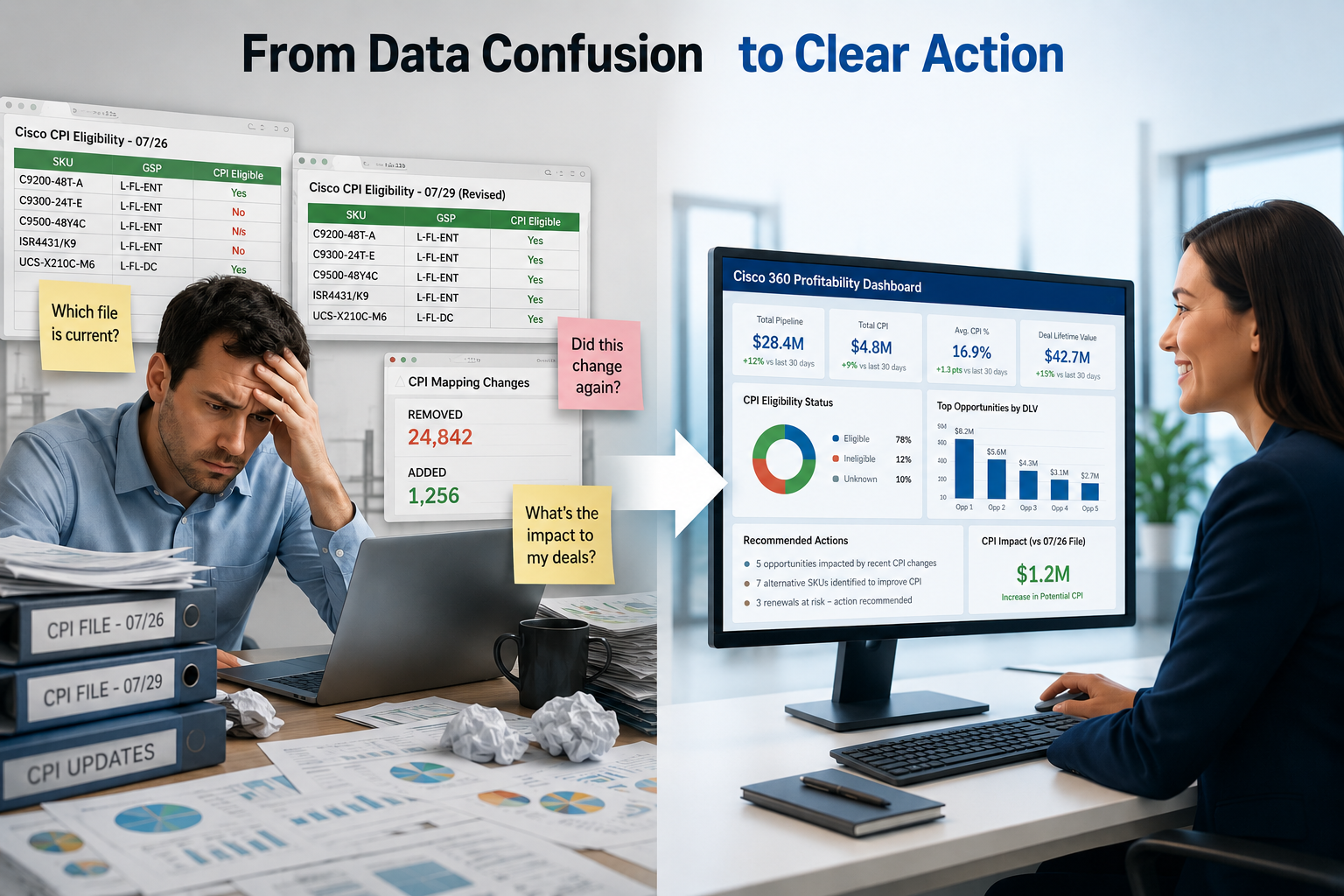
Just three days later, Cisco released a revised CPI file. While the July 26 changes generated significant attention, the July 29 revisions were published quietly, with no comparable communication explaining that most of the previously removed CPI mappings had been restored. Partners relying on the earlier files could easily be making quoting and profitability decisions based on outdated information.
The July 29 publication restored approximately 994,000 SKU-to-GSP mappings, reinstated 240 previously removed GSPs, and returned the program to almost exactly the same level as the June baseline.
This Blog has been updated to reflect the July 29 release and should be considered the current source of truth for Cisco FY27 CPI eligibility.
For readers interested in exactly what changed between the July 26 and July 29 publications, we’ve included a downloadable comparison at the end of this article.
What Changed?
Cisco’s July 29 update reversed the vast majority of the July 26 changes.
Current highlights include:
- 3,993,496 eligible SKU-to-GSP mappings
- 1,577 eligible GSPs
- Approximately 994,000 mappings restored from the July 26 publication
- 240 legacy GSPs reinstated
- Only two GSPs (AISS and OPT) remain largely removed
- Current mapping is actually slightly larger than the June 24 baseline, with 21 additional GSPs and nearly 20,000 more eligible SKU mappings.
Instead of representing a permanent restructuring of Cisco’s service mappings, the July 26 publication now appears to have been largely superseded by the July 29 update.
For partners who modified quoting strategies, service recommendations, or profitability models based on the July 26 files, it is worth reviewing those assumptions against the current eligibility data.
The Bigger Story Isn’t the Reversal
While the restored eligibility is certainly welcome news, the larger takeaway is how quickly—and sometimes quietly—the Cisco 360 incentive program can change. In this case, one of the largest reversals we’ve seen was published only three days after the original update, with little indication that partners should revisit their assumptions.
Within only three days Cisco restored nearly one million CPI mappings.
For partners, this reinforces several important realities:
- CPI eligibility can change between quoting and booking.
- Historical rebate assumptions quickly become outdated.
- Manual spreadsheets require constant maintenance.
- Every significant opportunity should be validated against current Cisco data before it is booked.
The July updates demonstrate that profitability under Cisco 360 is no longer something you calculate once. It must be continually validated as Cisco updates its incentive program.
Current FY27 Incentive Highlights
Although most legacy service mappings have now been restored, Cisco’s broader FY27 strategy remains unchanged.
The company continues directing partner profitability toward lifecycle engagement, recurring revenue, AI adoption, and customer success.
Several important FY27 changes remain in place.
AI Continues to Expand
Cisco continues investing heavily in AI-focused solutions.
FY27 introduced hundreds of new AI-related eligible offers while adding new AI Agent and AI Assistant incentive opportunities within the Collaboration portfolio.
Partners helping customers modernize infrastructure and prepare for AI-enabled workloads remain well positioned for future growth.
Networking Continues Its Evolution
Cisco retired numerous legacy Networking offers while introducing next-generation Catalyst, routing, switching, and TAA platforms.
The temporary FY26 Networking accelerator has effectively transitioned into the standard FY27 incentive model, encouraging partners to optimize architectures rather than chase short-term promotions.
Security and Splunk Continue to Converge
Cisco continues consolidating security incentives around Splunk and strategic security platforms.
Examples include:
- Cisco Identity Services Engine (ISE) incentives increasing from 2% to 6%
- Core Splunk incentives increasing from 2% to 4%
- Continued migration of several legacy security products into the Splunk portfolio
These changes reinforce Cisco’s long-term investment in integrated security and observability.
Lifecycle Profitability Remains the Focus
The biggest opportunity under Cisco 360 still extends well beyond the initial transaction.
Cisco continues rewarding partners that help customers:
- Adopt new technologies
- Expand deployments
- Renew subscriptions
- Refresh aging infrastructure
- Increase Annual Contract Value (ACV)
Winning the initial opportunity remains important.
Maximizing customer success throughout the lifecycle is where the greatest profitability now exists.
Why Manual Analysis No Longer Works
The July updates perfectly illustrate why traditional approaches to rebate forecasting are becoming increasingly risky.
Within a single week Cisco published two significantly different CPI mapping files.
Partners relying on downloaded spreadsheets or historical assumptions could easily make quoting decisions using outdated eligibility data.
Today’s questions are no longer simply:
- Is this product eligible?
- What rebate will I earn?
Instead, partners need to understand:
- Which Cisco products maximize CPI?
- Have alternate SKUs become more profitable?
- Which service combinations now qualify?
- How has Cisco changed the economics of this deal?
- Which customers should be targeted for Adopt, Expand, Renew, or Refresh initiatives?
Those answers increasingly require automated analysis using the latest Cisco incentive information.
Turning Cisco Data into Customer Action
As Cisco’s programs have evolved, so has AssetXpert™.
Built on Netformx’s long history of transforming Cisco data into actionable business intelligence, AssetXpert has evolved into the Cisco 360 Execution Platform. It unifies discovery, deal analysis, lifecycle intelligence, and customer success insights to help partners execute Cisco 360 more effectively across the entire customer lifecycle.
By combining the latest Cisco incentive intelligence with installed-base, contract, lifecycle, and discovery data, AssetXpert gives partners the visibility needed to make informed decisions before opportunities are booked while identifying the actions that maximize profitability long after the initial sale.
AssetXpert helps partners:
- Automatically analyze Cisco BOMs
- Model CPI and Deal Lifetime Value (DLV)
- Recommend alternative Cisco SKUs that may improve profitability
- Identify Land, Adopt, Expand, Renew, and Refresh opportunities
- Prioritize customer success activities
- Identify renewal and technology refresh opportunities
- Assess AI readiness by analyzing aging infrastructure, software lifecycle, security vulnerabilities, and modernization opportunities
Rather than treating each Cisco program as a separate initiative, AssetXpert brings together the intelligence partners need to execute Cisco 360 through a single platform that transforms Cisco data into prioritized customer actions.
Cisco 360 Will Continue to Evolve
If the July updates demonstrated anything, it’s that Cisco 360 is becoming increasingly dynamic.
Eligibility files, incentive mappings, service relationships, and portfolio strategies will continue to evolve as Cisco refines the Cisco 360 program. The July 29 revision also demonstrated that significant changes can be published with little notice, making it easy for partners relying on downloaded spreadsheets or one-time analyses to unknowingly work from outdated information.
The challenge is no longer simply understanding today’s incentive rules—it’s keeping pace as those rules continue to change. Profitability under Cisco 360 depends on using the latest incentive intelligence available at the time a deal is booked, not the data that was available when the quote was first created.
That is where platforms like AssetXpert provide lasting value. By continuously incorporating Cisco’s latest incentive data into deal analysis and lifecycle planning, partners can adapt to program changes as they happen rather than discovering their impact months later in rebate payments.
Instead of spending valuable time comparing Cisco workbooks and interpreting frequent program updates, partners can focus on helping customers adopt new technologies, expand their environments, renew subscriptions, modernize infrastructure, and prepare for AI initiatives—all while maximizing the profitability of every customer and every deal.
The competitive advantage is no longer simply having access to Cisco data.
It’s turning Cisco data into customer action.
Complimentary Limited-Time Offer
To help partners understand how these latest Cisco updates affect their business, Netformx is offering a complimentary Cisco CPI Profitability Review for a limited time.
We’ll review your current pipeline or your most frequently sold Cisco products and identify:
- Products that have gained or lost CPI eligibility
- Opportunities to improve profitability through alternate Cisco offerings
- Potential impacts on Deal Lifetime Value (DLV)
- Actions that can increase rebates before opportunities are booked
Learn more and request your complimentary review on our Offers page.
Download the July 26 vs. July 29 Comparison
This article reflects the current Cisco FY27 CPI eligibility as of Cisco’s July 29 publication.
If you’re interested in seeing exactly what changed between the July 26 and July 29 releases, Download the July 26 vs. July 29 Cisco CPI Comparison (PDF)
The detailed comparison shows:
- The restoration of nearly one million SKU-to-GSP mappings
- Reinstated service categories
- Remaining removals
- Net changes from the June baseline
- Recommendations for partners reviewing their current pipeline
Have Questions About Cisco 360?
If you’d like to discuss the July 29 CPI updates, understand how they affect your pipeline, or learn how AssetXpert helps partners stay current with Cisco’s rapidly evolving incentive program, I would be happy to help.
Request a demo today or contact sales@netformx.com to schedule your complimentary Deal Profitability Analysis.
About this Analysis
This analysis was prepared by Netformx based on Cisco Partner Incentive program documentation published for the transition from Cisco FY26 2H to FY27 1H. The objective is to help Cisco partners understand key program trends and their potential business impact. Cisco Partner Incentive programs remain subject to Cisco’s official documentation and updates.

What did Cisco change for incentives for FY27?
Cisco published major Cisco 360 CPI eligibility changes on July 26, 2026, removing nearly 25% of all SKU-to-GSP mappings before quietly releasing a revised file just three days later. The July 29 update restored most of the removed mappings, underscoring how quickly CPI eligibility can change and why partners need to validate profitability using the latest Cisco data. Read the Blog.